
Your cart
There are no more items in your cart
//
Vintage Saxophones Beyond Selmer
Discover American vintage saxophones beyond Selmer: history, iconic models, legendary musicians, and restored instruments available at Sax & Clarinet On.


 731
731

Compartir:


To say Selmer is to name the saxophone brand par excellence, much like Buffet is identified with clarinets. But the vintage saxophone universe is not limited to Selmer: there are lesser-known American brands, each with history, character, and a unique sound, that deserve to be rediscovered.
As you know, Adolphe Sax introduced the saxophone as a new instrument by performing a piece by Berlioz at the 1844 Paris Exhibition. From that moment, several genealogical branches of construction emerged, which history later validated for their authenticity and quality.
One of the branches that directly took over from Adolphe Sax’s first prototype was Rampone & Cazzani. Thanks to the friendship their family maintained with Sax, they developed a saxophone that, over the years, evolved into a model still produced today. To learn more about the brand’s history, you can check the post we published on the birth of Rampone & Cazzani.
Up to this point, everything was happening in Europe. But by the late 19th century, a true hub of instrument makers had emerged in the United States—specifically in Elkhart, Indiana. Why there? The story takes us back to the American Civil War: one Union soldier, C.G. Conn, returned to his hometown after the war and founded the first musical instrument factory in Elkhart. That initial spark gave rise to a flourishing ecosystem: brands like King, Martin, and Buescher established themselves nearby, some founded by former Conn workers who carried their expertise into new projects.
What common characteristic can we highlight in the construction of these brands that followed directly from Adolphe Sax’s legacy? A very important one: the alignment of the tone holes for the left and right hand on the saxophone’s body. This decision not only affects ergonomics, but also intonation and timbre. Interestingly, Selmer modified this design starting with the 1947 Super Action, rotating the right hand outward; before that, their models also kept the tone holes perfectly aligned, just like the American brands of the time.
Rampone & Cazzani also stopped producing aligned tubes, as Selmer did, but they maintained (still today) another feature in common with the Elkhart makers: slightly larger bore dimensions, which give the instrument a deep, full sound.
We begin with Buescher, whose most appreciated models include the New Aristocrat and the Big B. The brand played an important role both in classical music—thanks to figures like Sigurd Rascher—and in jazz. Let’s not forget Duke Ellington’s lead alto, Johnny Hodges, whose characteristic vibrato shone on his Buescher 400.
Visit our vintage section to try these magnificent Buescher instruments.
Martin is also worth highlighting. While their Committee trumpet “The Martin” gave voice to Miles Davis, their saxophones are equally incredible. The bell engravings, from altos to trombones, are spectacular. None other than Art Pepper played a The Martin. The Martin Magna was the most luxurious model of its time, though it never reached Selmer’s prices. We still have one with a solid silver neck—an extremely rare example, as very few were produced:
Martin Magna Tenor
King was used at different stages of their careers by Charlie Parker and Sonny Rollins. No wonder Yanagisawa took inspiration for its AWO33 and TWO33 models! With a solid silver bell and neck and octave key under the neck, the acclaimed King Super 20—especially in Silver Sonic or Full Pearls versions—remains a favorite among collectors and musicians seeking that classic American sound.
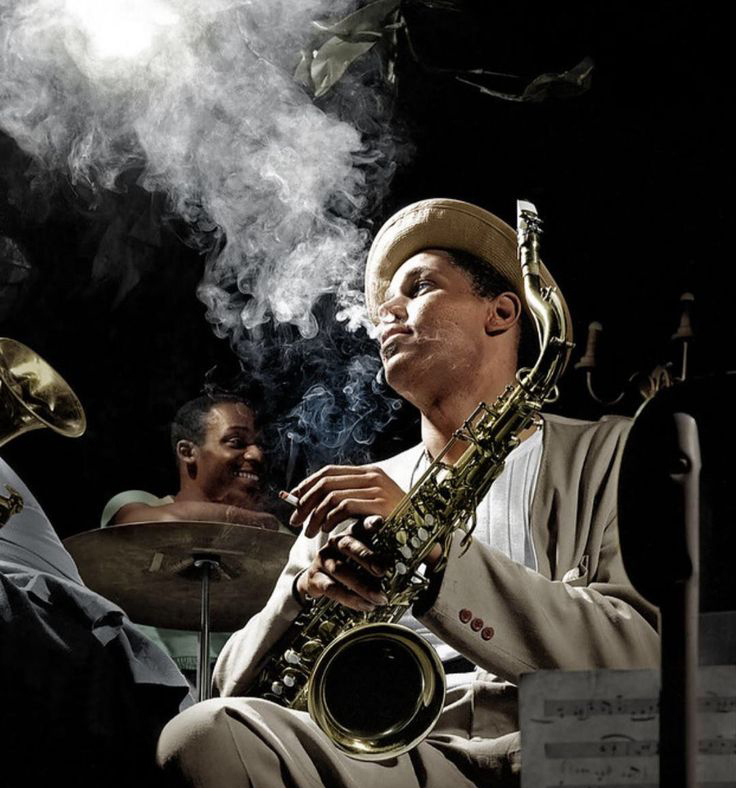
Finally, Conn, the largest American instrument maker of its time, was able to supply not only musicians but also countless bands and even the U.S. Army. A true giant of the saxophone. Dexter Gordon was a passionate Conn player, performing on models like the 10M—nicknamed “Lady Face” for its engraving—or the 30M Conqueror. Charlie Parker, always using whatever was at hand, also played a Conn 6M, in addition to the famous Grafton. Here at Sax & Clarinet On we still have a restored unit, ready for the stage:
Vintage Grafton Alto
To conclude, we want to highlight that a Conn, Martin, Buescher, or King saxophone, when restored by a skilled professional, offers a level of quality and a truly vintage “flavor” that any music lover will appreciate. And today, these saxophones are still not in the highest price ranges of the market, making them a unique opportunity to enjoy the sound of past eras without overspending.
Jorge S.
2025-09-30 13:08:33
Muy interesante. Gracias por una lectura interesante. Un saludo.
Jacqueline Maribel
2026-01-29 10:31:10
Muy interesante :)


Escribe un comentario